
Linkage
Concept Card #02.01.04
This concept informs Barbara's research on strategic uncertainty and innovation ecosystems.
Definition #02.01.05
What Is Linkage?
Linkage is the process through which relationships between local developments become visible, allowing larger patterns and structures to emerge.
Individual signals rarely explain strategic change on their own. A new technology, policy decision, consumer behavior, infrastructure constraint, or social tension may appear relatively simple and clear when viewed in isolation. Their true impact emerges only when their relationships become visible.
Linkage explains why strategies focused on singular developments are at best suboptimal.
Individual signals rarely explain strategic change on their own. A new technology, policy decision, consumer behavior, infrastructure constraint, or social tension may appear relatively simple and clear when viewed in isolation. Their true impact emerges only when their relationships become visible.
Linkage explains why strategies focused on singular developments are at best suboptimal.
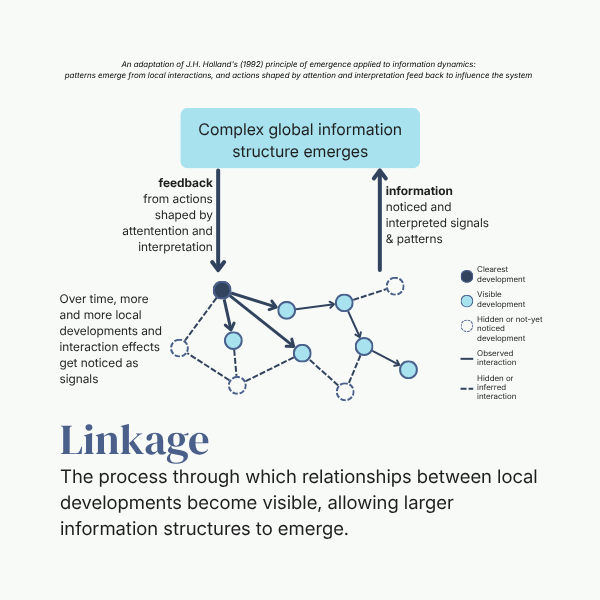
An adaptation of J.H. Holland's (1992) principle of emergence applied to information dynamics:
patterns emerge from local interactions, and actions shaped by attention and interpretation feed back to influence the system.
patterns emerge from local interactions, and actions shaped by attention and interpretation feed back to influence the system.
Characteristics
Exercise #02.06.06
Which developments appear unrelated but may be contributing to the same emerging structure?
Example Case #02.02.04
H-Transition - TaTa Steel NL
When stakeholders in the IJmond region explored the implications of green steel production, they initially focused on the steel plant itself. However, connections emerged with energy infrastructure, workforce development, housing, logistics, education, and regional planning. The strategic challenge was not located within any single domain. It emerged from their interactions. Recognizing these linkages transformed the issue from an industrial project into a regional systems challenge.
Field Note (to consider) #02.05.05
Strategic surprise rarely is a black swan, but mostly a surge in developements you weren't aware of.
Metaphor
Mushroom Mycelium
An invisible thread-like network called mycelium connects the mushrooms on an old tree trunk. The mushrooms are its "fruit". Because this sprawling underground web shares water, nutrients, and even electrical warning signals among plants and trees, it is also known as the wood-wide-web.
Mycelium illustrates how decentralized, interdependent components link together to form a resilient, self-regulating network. In strategy information, linkage refers to the extent to which different systems, departments, or business units rely on each other to execute overarching goals.
Mycelium highlights three core linkage dynamics: decentralized coordination, resource distribution, and symbiosis.
While mycelium allows for rapid adaptation, it also dictates that disturbances in one node can ripple through the entire interconnected web. Understanding these "wood-wide-web" dynamics helps you design organizations that are robust, cooperative, and responsive to rapid shifts in its environment.
Mycelium illustrates how decentralized, interdependent components link together to form a resilient, self-regulating network. In strategy information, linkage refers to the extent to which different systems, departments, or business units rely on each other to execute overarching goals.
Mycelium highlights three core linkage dynamics: decentralized coordination, resource distribution, and symbiosis.
While mycelium allows for rapid adaptation, it also dictates that disturbances in one node can ripple through the entire interconnected web. Understanding these "wood-wide-web" dynamics helps you design organizations that are robust, cooperative, and responsive to rapid shifts in its environment.
Exercise (team) #02.06.06
Seeing the Structure
Choose a strategic issue facing your organization.
List five developments that may influence it.
For each development, ask:
- Which other developments does it influence?
- Which developments influence it?
- What larger pattern might emerge if these interactions continue?
The goal is not to predict the future.
The goal is to recognize how interactions between developments can create structures that are difficult to see when each development is considered separately.
Tips #02.07.04
How to Recognize Linkage
Effective filtering becomes visible through recognizable organizational behaviors:
Linkage often reveals itself through recurring patterns:
- Ripple Effects – changes spread beyond their original domain
- Cascading Effects – consequences unfold through chains of interactions
- Convergence – previously separate developments begin interacting
- Entanglement – developments become increasingly difficult to separate
- Scope Expansion – local issues gradually acquire broader significance
- Serendipity – unexpected combinations create new opportunities
These patterns are often early indications that larger structures are emerging.