
Delay
Concept Card #01.01.03
This concept informs Barbara's research on strategic uncertainty and innovation ecosystems.
Definition
What Is Delay?
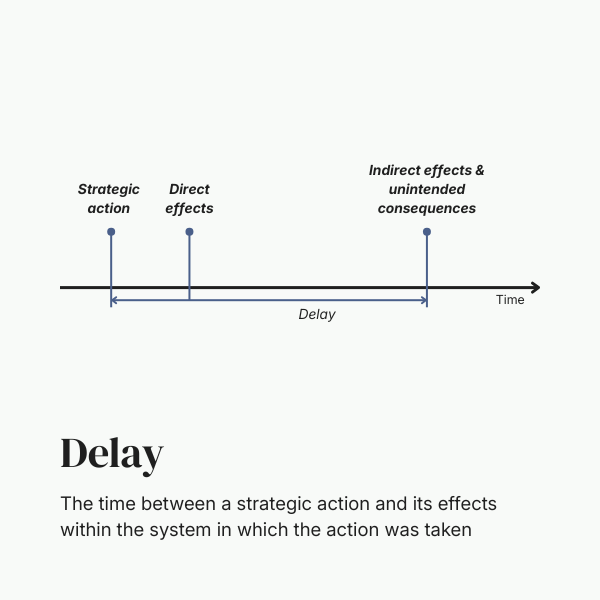
A delay is the time between an action, change, or decision and its visible effects within a system*).
In unstable systems, causes and consequences often do not appear at the same moment. Effects may emerge slowly, indirectly, or somewhere else in the system entirely.
This makes systems difficult to interpret while they are changing.
In unstable systems, causes and consequences often do not appear at the same moment. Effects may emerge slowly, indirectly, or somewhere else in the system entirely.
This makes systems difficult to interpret while they are changing.
*) A system is the wider network of people, organizations, infrastructure, resources, rules, and dependencies that an organization relies on and influences.
Effects
Challenges Caused by Delay
Example Case 01.02.01
Greenhouse effects
For many years, greenhouse gas emissions appeared to have limited immediate effects on daily life. The climate system continued functioning largely as expected, and the delay between emissions and visible consequences made the risks easier to underestimate.
But climate systems respond slowly. Heat accumulates over time. Oceans absorb energy gradually. Ice melts over decades. As a result, many of the effects visible today are connected to decisions, emissions, and industrial developments from years earlier.
The delay between cause and consequence made the system appear more stable than it actually was.
But climate systems respond slowly. Heat accumulates over time. Oceans absorb energy gradually. Ice melts over decades. As a result, many of the effects visible today are connected to decisions, emissions, and industrial developments from years earlier.
The delay between cause and consequence made the system appear more stable than it actually was.
Strategy Impact
Why Delay Matters
Delays make systems difficult to interpret while they are changing. Decision-makers may believe a policy is successful because no visible problems have appeared yet, while important consequences are still developing beneath the surface.
At the same time, actors may respond to visible disruptions without realizing that the real causes emerged years earlier. This can create cycles of delayed reaction, short-term thinking, and interventions that unintentionally increase instability elsewhere in the system.
At the same time, actors may respond to visible disruptions without realizing that the real causes emerged years earlier. This can create cycles of delayed reaction, short-term thinking, and interventions that unintentionally increase instability elsewhere in the system.
Delays can create the illusion that:
- a decision has no consequences,
- a policy is working,
- a risk is under control
By the time the effects become visible, the system may already have changed significantly.
In complex systems, actors often respond to what they can already see, while important consequences are still developing underneath the surface.
- a decision has no consequences,
- a policy is working,
- a risk is under control
By the time the effects become visible, the system may already have changed significantly.
In complex systems, actors often respond to what they can already see, while important consequences are still developing underneath the surface.
Exercise 01.06.04
Thinking Prompt
What happens when political, economic, or organizational time horizons are shorter than the delays inside the system?
Causes
Why Do Delays Happen?
Delays happen because systems do not respond instantly to change. Information, materials, investments, decisions, and consequences often move through many interconnected actors and processes before their effects become visible.
Some delays are physical or structural. Infrastructure takes years to build, ecosystems respond gradually to pressure, and demographic or economic changes unfold over long periods of time. Other delays emerge because actors rely heavily on short-term signals.
When consequences are not immediately visible, systems can appear stable even while pressure quietly accumulates underneath the surface.
Some delays are physical or structural. Infrastructure takes years to build, ecosystems respond gradually to pressure, and demographic or economic changes unfold over long periods of time. Other delays emerge because actors rely heavily on short-term signals.
When consequences are not immediately visible, systems can appear stable even while pressure quietly accumulates underneath the surface.
Tips 01.07.01
How to Recognize Delay
When you know what to look for, you can start recognizing signs of delay.
- problems appearing long after the decisions that contributed to them
- policies producing unintended effects in other sectors
- growing gaps between short-term indicators and long-term developments
- repeated cycles of reacting too late