Intro Video #03.04.01
Collection #03

Technology Expectations

The collection “Technology Expectations” is essentially about one core question:

How do expectations of emerging technologies shape strategic HR decisions and vice versa?

Everything in the collection connects back to that.

Organizations increasingly have to make strategic HR decisions before the impact of emerging technologies becomes clear. They invest in skills, redesign jobs, automate processes, recruit new talent, and develop capabilities based not on what technologies have already changed, but on what they expect technologies might change in the future.

Simultaneously. organizations invest in particular skills, create demand for new expertise, or reorganize work around anticipated technologies, they influence the labor market, education systems, innovation ecosystems, and ultimately the speed and direction of technological adoption itself.

Understanding the relationship between expectation and influence reveals that technology and workforce development do not evolve independently. They co-evolve through a continuous process of expectations, decisions, and feedback. Organizations that understand this dynamic are better able to avoid preparing for the wrong future, recognize emerging capability needs earlier, and make more robust decisions under conditions of uncertainty.
In this collection:

Research objects exploring technology expectations, anticipation, forecasting biases, expert judgment, capability formation, diffusion mechanisms, reflexivity, and other processes through which organizations make decisions about emerging technologies under uncertainty.

Fieldnote to consider #03.05.01

AI does not change the labor market. It's organizational action that changes the labor market with AI.

Definition #03.01.01

Why do we use technology expectations?
→ to prepare organizations for potentially significant technological developments before their impact becomes visible

Technology Expectations are part of...
→ strategy, innovation, organizational development, investment decisions, and long-term planning

Technology Expectations are caused by...
→ emerging technologies, market developments, competitive pressures, changing customer needs, policy shifts, and broader societal change

Technology Expectations can be compared to...
→ assumptions about the future, strategic hypotheses, technology forecasts, scenarios, and future business opportunities

Technology Expectations are beliefs about how emerging technologies may develop and affect organizations, which guide decisions long before the actual development and impact is known.

Examples of Technology Expectations:
→ AI will transform knowledge work, robotics will increase productivity, quantum computing will create new competitive advantages, hydrogen technologies will reshape industrial value chains

Working with Technology Expectations leads to:
→ earlier preparation, better investment decisions, improved strategic positioning, greater organizational adaptability, and reduced strategic surprise

Working with Technology Expectations consists of:
→ monitoring technological developments, exploring future implications, testing assumptions, assessing opportunities and risks, and evaluating strategic options

How do we use Technology Expectations?
→ as inputs for decisions about strategy, innovation, investment, organizational capabilities, partnerships, workforce development, and long-term competitiveness


Concept Cards #02.01.01-04

Technologal development ∞ strategic decisions

Four dynamics explain how emerging technologies and organizations continuously shape one another under uncertainty. Expectations influence decisions, decisions influence technological development, technological development creates new capability requirements, and the availability of capabilities influences the diffusion and impact of technology. The relationship is therefore not linear but a continuous process of co-evolution.
Like sailors continuously interpret clouds, wind, pressure, and temperature to anticipate what may happen next, we monitor emerging technologies to guesstimate the future.

Expectation Formation

**Sensemaking Dynamic** Because the future impact of a technology cannot be observed directly, organizations rely on assumptions, forecasts, expert opinions, narratives, and strategic interpretations. These expectations shape how decision-makers perceive opportunities, risks, and future capability needs.
Like the beaver builds a dam, changing the river, that changes the the beaver's habitat, so shape organizations the technological development that shapes organizations.

Reflexivity

**Anticipation dynamic** Organizations make decisions based on their expectations about technology, but those decisions also influence how technologies develop, spread, and create value. Expectations are therefore not passive predictions of the future; they actively contribute to shaping the future they anticipate.
Flowers evolve characteristics that attract pollinators. Pollinators evolve characteristics that help them access flowers. Technologies create demand for capabilities, while capabilities enable technologies.

Co-evolving Capabilities

**Adaptation Dynamic** New technologies create demand for new skills, knowledge, and organizational practices, while the availability of those capabilities influences whether and how technologies can be adopted. Technologies and capabilities therefore evolve together rather than independently.
Like a successful harvest needs more than seeds alone, a technology needs an ecosystem to develop.

Diffusion Dynamics

**Propagation Dynamic** The impact of a technology depends not only on its technical potential, but also on the speed and pattern of its adoption. Expectations, investments, skills, regulations, infrastructure, and ecosystem development all influence whether a technology remains a niche innovation or becomes widely used.
Assignment #03.06.01

Reflexivity Check

Choose an emerging technology relevant to your organization. What decision is your organization already making because of this technology? Complete the sentence:

Because we expect ________, we are currently ________.
ExampleVideo DotCom Bubble #02.04.02
Parallels between the dotcom bubble and AI development?

The real question is:

How expectations of shape your decisions today
Flashcard #03.03.01 to 04
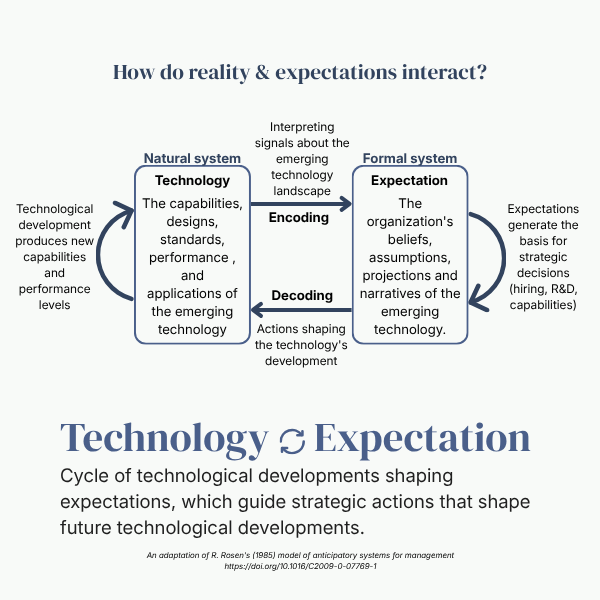
Explore the underpinning model first. Hover or click the card to reveal what it explains, why it matters, and when to use it.
A drawing of the Rosen model explaining the cycle of technological developments shaping expectations, which guide strategic actions that shape future technological developments.
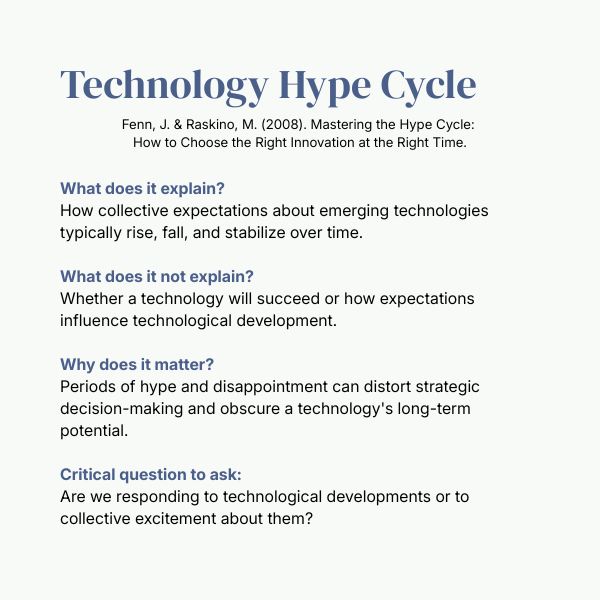
Graph showing the progression of collective expectations about an emerging technology as the technology's actual capabilities and applications become better understood.
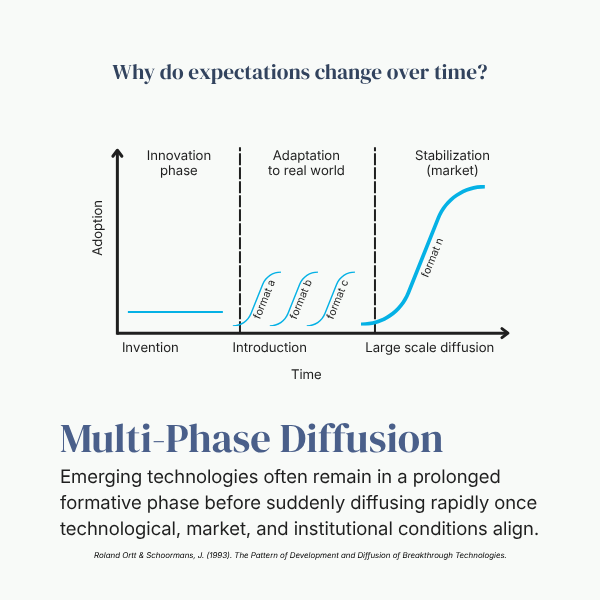
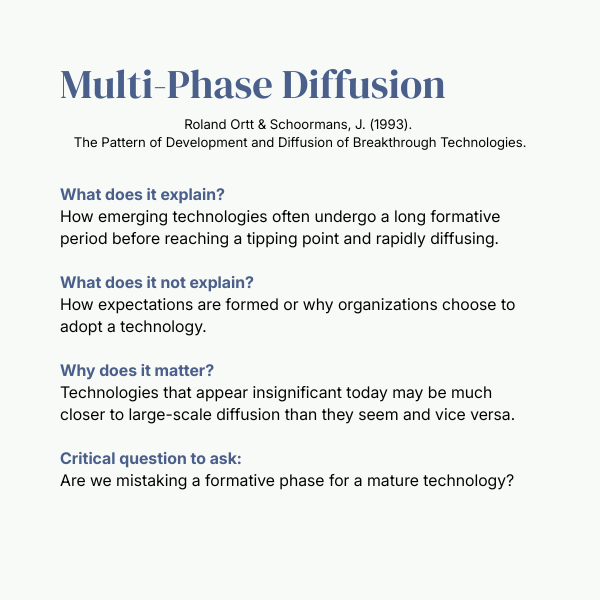
Graph of a three-phased model of technology diffusion (innovation, adaptation, and stabilization)
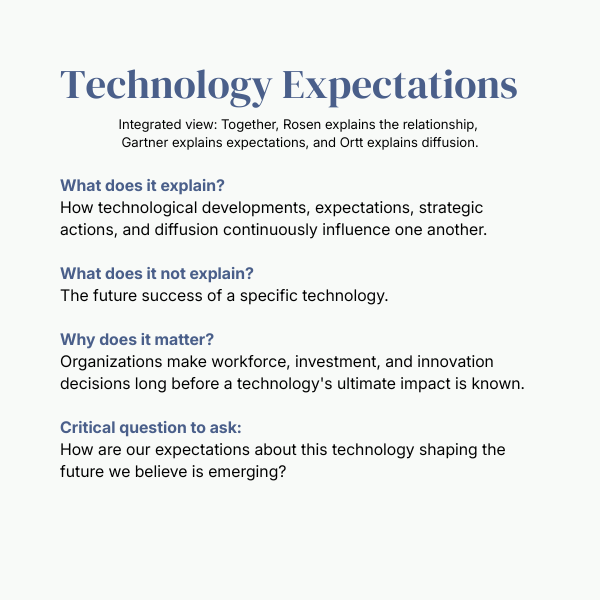
Integrated view, whereby the hype cycle and diffusion models together explain the link between technology and expectations of the technology (encoding)
Examples #03.02.1-4

Manifestations

Four examples of early technology expectations that only partially became true.

  1. European leaders present hydrogen policies under the Green Deal during a public announcement on Europe's future energy transition (2020)

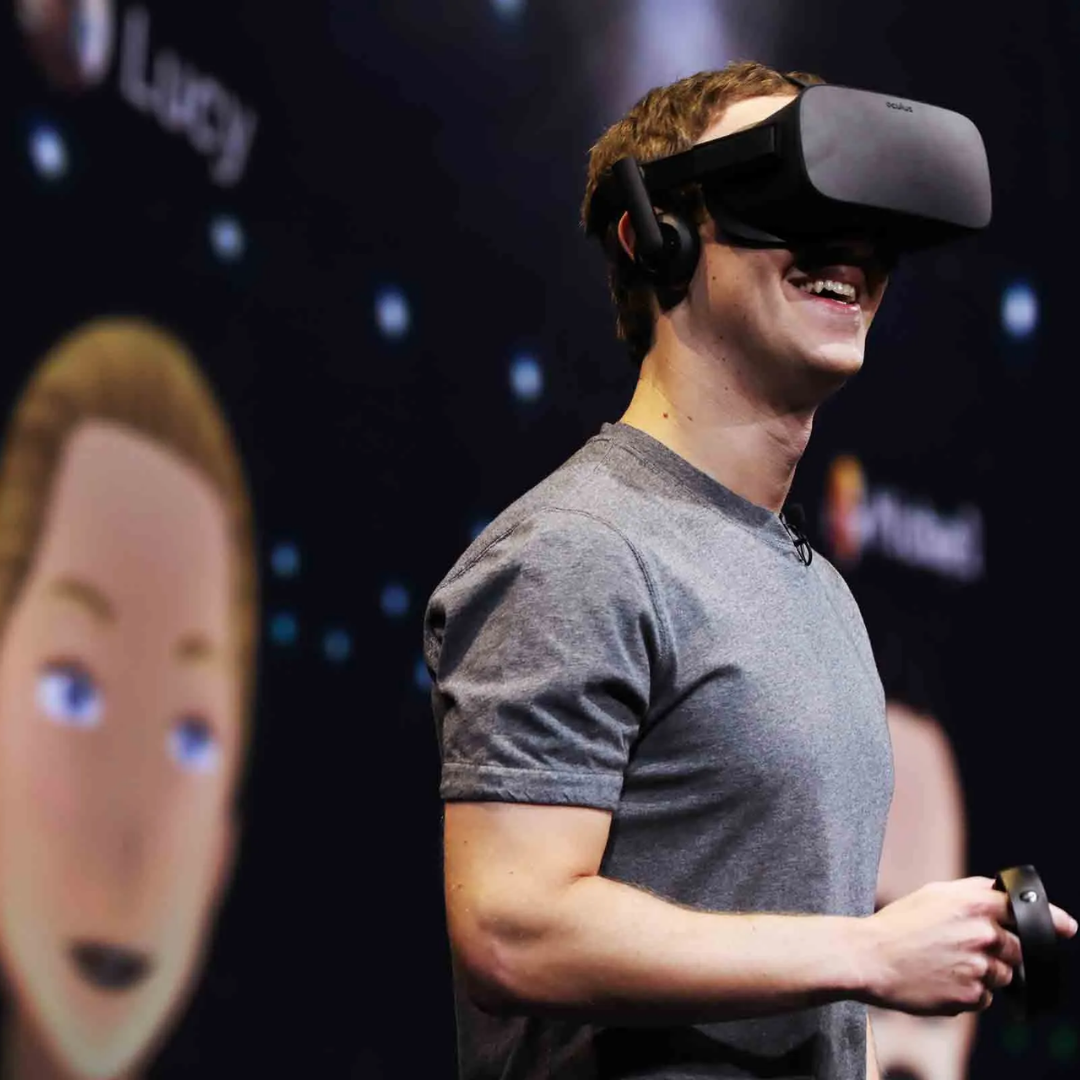
  2. Marc Zuckerberg presents the metaverse vision during a corporate event, introducing a new strategic direction for the company (2021)

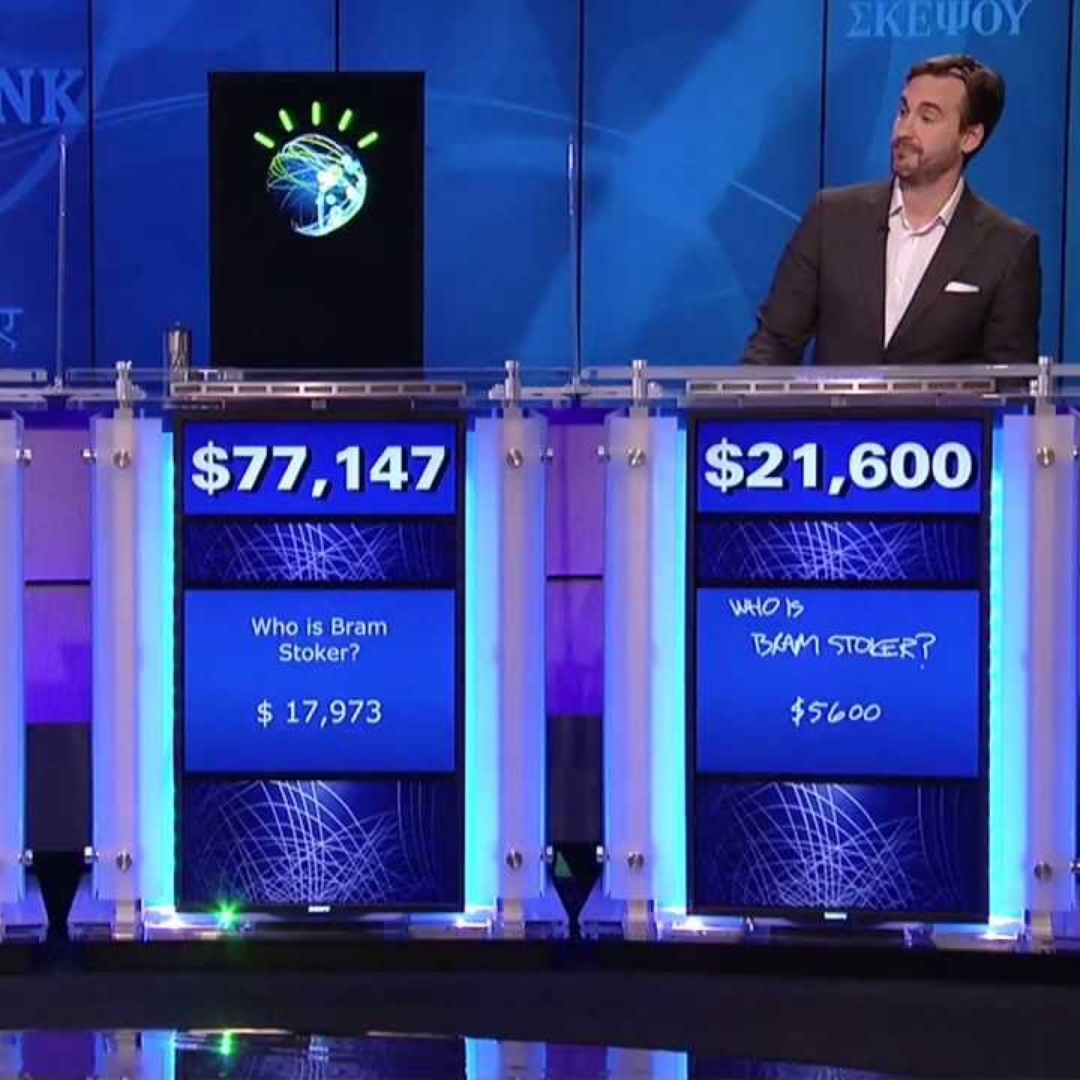
  3. Contestants stand on the Jeopardy! stage as IBM Watson wins the quiz show, demonstrating advances in artificial intelligence (2011)

  4. Researchers present Google's quantum computing breakthrough during a widely reported announcement about quantum supremacy (2019)

Hover or click the image for how the expectations turned out.
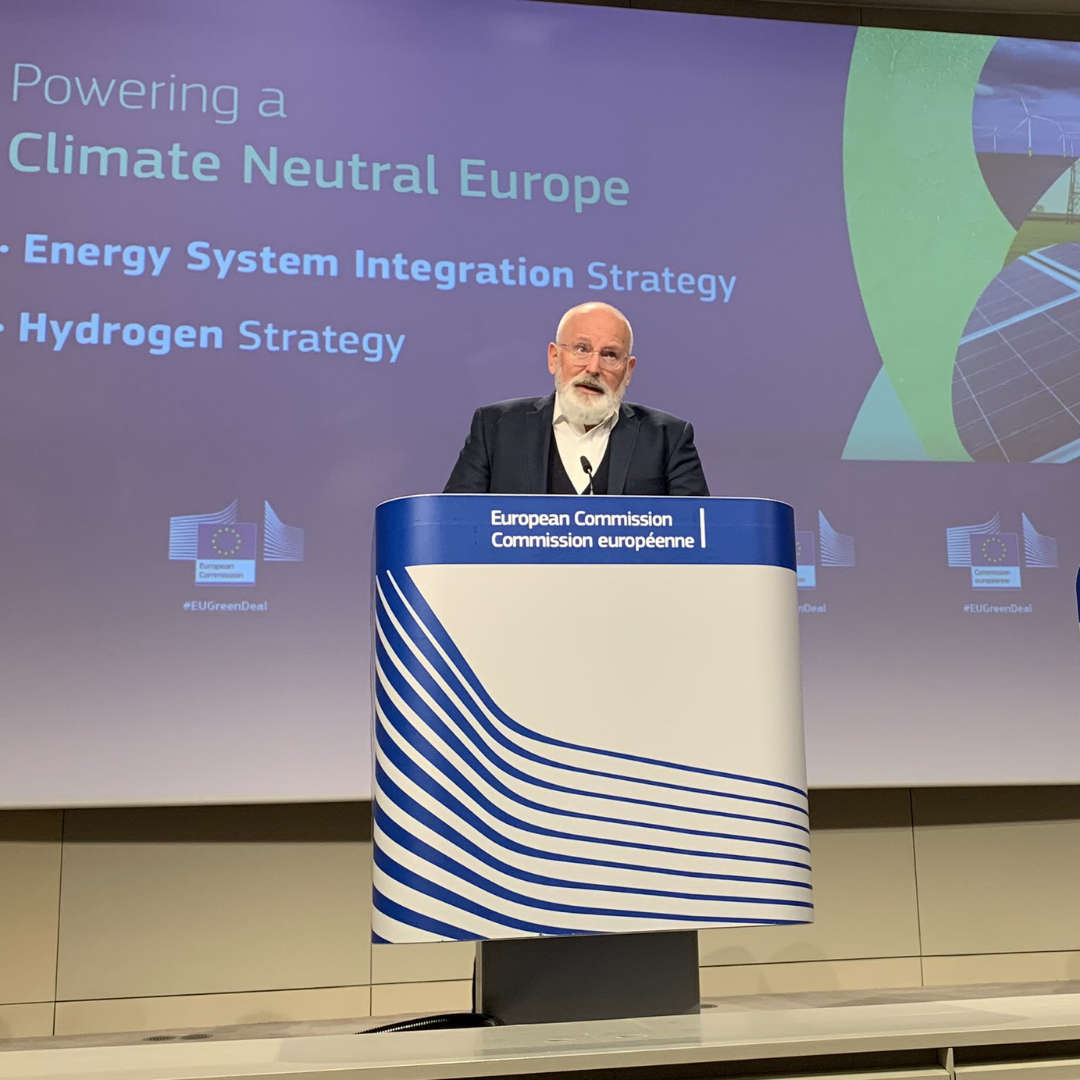
EC Hydrogen expectations
Hydrogen is becoming important in heavy industry, but adoption has been slower and more difficult than many early expectations suggested.
Facebook Metaverse Expectations
The metaverse triggered massive investments, but adoption has remained far below the expectations that originally motivated those investments.
IBM AI Expectations
Watson itself did not scale or transform business, but it helped signal the broader rise of AI that eventually did.
Contestants stand on the Jeopardy! stage as IBM Watson wins the quiz show, demonstrating advances in artificial intelligence (2011)
Google Quantum Computing Expectations
The breakthrough was real, but the timeline and ultimate impact of quantum computing remain uncertain.
Google presents its quantum supremacy milestone, strengthening expectations that quantum computing could transform future technological capabilities (2019)
Exercise #02.06.02

Which Assumption Is Aging Fastest?

Ask your team: Which assumption behind our strategy feels increasingly unstable?

Think about assumptions on: customer behavior, labor availability, energy costs, trust, growth, infrastructure, expertise or regulation

Applying These Ideas

The concepts in this collection have been used in executive education, technology foresight projects, innovation ecosystem studies, and strategic decision-making exercises.

Learn more about:

Back to the collections

Collections on unstable systems and strategic information
Take me back
Understanding how change emerges under uncertainty.
For you?
For decision-makers and research institutions exploring questions related to systemic uncertainty, anticipation, and emerging technologies
© 2026 FuturistBarbara.com. All rights reserved.